There is a quiet shift happening in how people get married, and it doesn’t announce itself with big headlines or dramatic declarations. You notice it in smaller ways. A friend mentions they are “just doing the registry office,” but the way they say it doesn’t sound like a compromise anymore. It sounds like an intention. A couple books a civil ceremony in the morning and plans nothing else for the rest of the day, not because they are skipping celebration, but because they don’t feel the need to stretch the moment into something larger.
Civil weddings used to sit in the background of wedding culture, almost like a technical step you had to pass through before the “real” celebration. The language around them reflected that: quick, simple, administrative, practical. Rarely emotional. Rarely aspirational. That framing is starting to feel outdated.
Across Europe and beyond, registry office weddings and courthouse ceremonies are no longer being treated as placeholders. They are becoming the main event for a growing number of couples who are rethinking what a wedding is actually supposed to feel like. Not performative. Not inflated. Not necessarily designed for an audience. But clear, present, and emotionally direct. And strangely enough, the less these weddings try to “be” something, the more meaningful they often become.
Where it all began
To understand why civil weddings are having this moment, you almost have to zoom out. It’s not really a wedding industry story at first. It’s a lifestyle story.
Over the past decade, people have started questioning scales in almost every part of life. Travel became more intentional. Work stopped being automatically tied to identity. Interiors moved toward fewer objects, more space. Even celebrations – birthdays, dinners, gatherings – became less about hosting “events” and more about creating atmosphere.
Weddings followed the same curve, just more slowly, because weddings carry expectations. Family expectation. Cultural expectation. The expectation that this is supposed to be the biggest day of your life, and therefore it should look like it. But somewhere along the way, couples began asking a very simple question, often quietly, sometimes almost apologetically: Do we actually want all of that?
Not because they don’t value celebration. Not because they are less romantic. But because the shape of traditional weddings – with their layered logistics, extended guest lists, and carefully staged emotional beats – doesn’t always match how people want to experience something as personal as marriage.
Civil ceremonies, in contrast, offer something different. Not less. Just stripped of excess pressure. A room. A few people. A short sequence of words that are surprisingly difficult to say without meaning them. And then it’s done. Or rather, it begins.
Photo: PINTEREST
The unexpected return of emotional clarity
One of the most interesting things about civil weddings is how often couples misjudge them beforehand. There is usually an assumption that because the format is simple, the emotional impact will also be smaller. That meaning needs scale to exist. That a moment needs staging to feel significant. But in practice, something else happens. The simplicity removes distraction.
There is no waiting for dinner service to finish. No timeline of speeches unfolding across hours. No movement between spaces that breaks emotional continuity. The ceremony becomes a single, uninterrupted moment where attention is not divided between logistics and feeling.
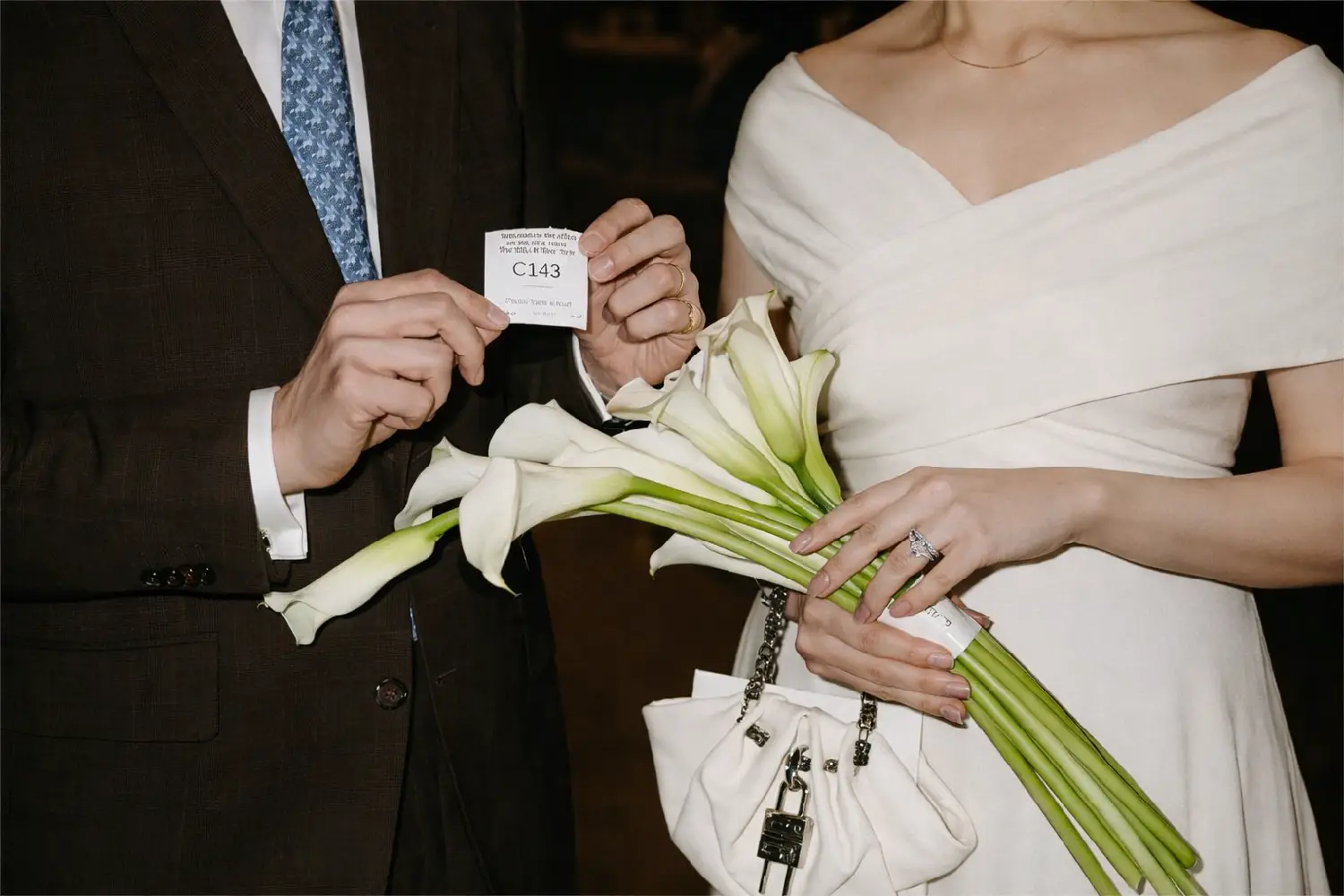
A registrar speaks. Names are confirmed. There is often a small pause that feels longer than it is. Someone laughs unexpectedly because the tension needs somewhere to go. And then suddenly the words that define the entire day are spoken, and nothing about them feels small.
Afterwards, couples often don’t remember the structure of the ceremony. They remember fragments. The sound of paper being handled. The light in the room. A parent gripping a chair a little too tightly. The feeling of stepping outside and realizing that life continues immediately, unchanged and completely different at the same time.
Civil weddings don’t amplify emotion. They reduce interference. That is a subtle distinction, but an important one.
Photo: PINTEREST
People want to feel their own wedding now
Wedding planners talk about civil ceremonies differently than they did even five years ago. Not as a budget decision or a minimalist choice, but as a shift in emotional priorities.
In a traditional format, the couple is constantly switching roles. One moment they are emotional subjects of the day. The next they are logistics coordinators checking if guests have arrived, if timing is on track, if the photographer is ready, if dinner is running late.
In a civil ceremony, that fragmentation largely disappears. There is no extended production layer. The experience is compressed, but not rushed. Focused, but not controlled.
Photographers notice this too. They talk about how couples behave differently in registry office weddings - less posing, more reacting. Less awareness of the camera, more awareness of each other. One photographer described it as “less performance, more proximity.”
Photo: PINTEREST
The aesthetic shift: restraint is no longer absence
Civil weddings also look different, but not in the way wedding trends usually change. There is no dominant theme. No shared visual code. Instead, there is a kind of aesthetic restraint that feels almost accidental, but increasingly intentional.
City halls and registry offices are not typically designed as romantic spaces. That is partly why they work. They don’t demand transformation. A marble staircase, a municipal hallway, a room with tall windows - these spaces carry a neutrality that allows people to define the atmosphere themselves.
The bridal style has adapted to that environment. Structured tailoring, silk dresses that move easily, minimal accessories that don’t compete with the setting. Not “less bridal,” but less separation between person and place.
This shift is also reshaping bridal fashion itself. Many civil brides are moving away from traditional expectations and gravitating toward silhouettes that feel refined, architectural, and effortlessly personal. Designers like NEWHITE | Modern Bridal, whose simple lines and subtle refinement are perfect for a city hall, old registry office, or small-scale urban ceremony, have come to represent this new style. The focus is no longer on dressing for spectacle, but on choosing pieces that feel authentic to the woman wearing them.
There is also something quietly modern about walking out of a civil ceremony directly into a city street. No staged exit. No transition designed for photographs. Just the sudden shift from formal declaration to everyday life. And somehow, that contrast is what makes it memorable.
It would be incorrect to frame civil weddings as a replacement for traditional celebrations. Both still exist. Both are evolving in parallel. What has changed is the assumption that there is a single “correct” format for a wedding.
Some couples still want large gatherings, multi-day celebrations, destination experiences that feel closer to festivals than ceremonies. Others choose registry office weddings followed by an intimate dinner. Many do both – separating legal formality from celebration entirely.
The centre of gravity has shifted from “how weddings should look” to “what this moment means for us.” And that is where civil weddings sit comfortably. They are flexible without being vague. Structured without being heavy. Short without feeling incomplete. They don’t try to define marriage. They simply mark it.
Photo: PINTEREST
A quieter definition of luxury
If there is one broader cultural shift reflected in civil weddings, it is the redefinition of luxury. Luxury used to be associated with accumulation – more guests, more detail, more visual impact. But increasingly, luxury is being associated with something less visible: ease. Ease of experience. Ease of emotion. Ease of being present without splitting attention across too many moving parts.
In that sense, a civil ceremony can feel unexpectedly aligned with contemporary luxury thinking. Not because it is extravagant, but because it removes friction from a significant life moment. There is a kind of precision in that – not aesthetic precision, but emotional precision. A wedding that doesn’t try to extend itself beyond what it needs to be. And for many couples, that is exactly the point.
The way weddings are organized is also being impacted by this change in the definition of luxury. Many couples are looking for experiences that feel deliberate and intimate rather than just spending a lot of money. This idea has helped international planning firms like The Wedding Privé establish their name by crafting highly customized festivities for couples with a global perspective that value purpose, seclusion, and narrative over tradition. The goal is the same whether the celebration takes place in one city or several locations: to create an experience that feels purposeful from the start.
Photo: PINTEREST
The reality of a civil wedding
There is a version of a civil wedding that exists in imagination, and then there is the one that actually unfolds on the day. The imagined version is often neat. Calm. Almost understated in a perfectly composed way, like a quiet editorial shoot where everyone knows exactly where to stand. The real version is more textured.
Someone is usually slightly late, not dramatically, but enough that time feels like it softens at the edges. A bouquet is adjusted three times because it doesn’t sit quite right in the hand. There is often a small conversation outside the registry office that has nothing to do with logistics – something about nerves, or forgetting to eat, or the strange feeling that life is about to shift in a way that still hasn’t fully arrived.
Inside, the room is rarely impressive in a traditional sense. That is part of its strange power. It does not try to compete with emotion. It simply holds it. A registrar speaks in a voice that is practiced but never detached. There is a rhythm to it – efficient, but not cold. Names are confirmed. Documents are checked. The structure of legality quietly supports something that is not legal at all: emotional commitment.
Photo: PINTEREST
And then there is a moment that almost always feels smaller than expected, and somehow bigger at the same time. The exchange of vows, even when simple, tends to land with more weight precisely because nothing around it is trying to amplify it.
People often describe a strange contrast afterwards. The ceremony itself is short enough to fit into a lunch break in theory, but emotionally it doesn’t behave like something short. It stretches in memory. It slows down in hindsight.
Outside the building, life resumes immediately. Cars pass. People check phones. Someone suggests lunch. And the couple – now legally married, though that fact takes a while to fully register - steps back into a world that looks exactly the same, except it isn’t. There is no official transition. No curtain closing. Just movement from one state to another, with no clear border between them.
Photo: PINTEREST
What photographers see that guests don’t always notice
Photographers often describe civil weddings as “honest in a way larger weddings sometimes aren’t.” Not because other weddings are staged in a false sense, but because there is less structure to hide behind.
In a traditional wedding, moments are often framed. There is time to prepare for reactions, to position people, to anticipate emotional beats. In a civil ceremony, things happen slightly faster than intention can fully organize. That creates a different kind of imagery.
A hand squeezing another hand a fraction too tightly. A smile that appears mid-sentence rather than at the end of it. The way someone exhales after saying “yes” as if they didn’t realize they were holding their breath.
Intimate celebrations photographers often talk about the emotional transparency of civil marriages. The small moments that characterize these ceremonies, such as the gaze shared before entering the chamber, the anxious giggle during vows, and the relief that settles in following, are frequently recorded by luxury wedding photographer Anni Graham, who is renowned for her journalistic yet profoundly personal approach to storytelling. These are times when staging is rarely necessary because everything that counts is already present.
Photographers talk less about composition in these settings and more about timing. Civil weddings don’t wait for perfect conditions. They move, and you either catch them or you don’t. This is why the resulting photographs often feel less like documentation of an event and more like fragments of something lived. Not polished. But present.
Photo: PINTEREST
Fashion in civil weddings
One of the clearest visual shifts in civil weddings is how people dress - but not in a trend-driven way. It is less about replacing one aesthetic with another and more about reducing the distance between everyday identity and ceremonial identity.
There is still elegance, but it behaves differently. A silk dress that doesn’t need adjusting every five minutes. A tailored suit that looks like it could belong in both a ceremony and a dinner afterward without feeling out of place in either. Shoes are chosen not only for appearance but for walking through city streets afterwards.
Bridal fashion in civil weddings often avoids the idea of transformation. Instead of becoming someone else for the day, there is a subtle heightening of who already exists. Accessories tend to follow the same logic. Fewer pieces, but more intentional ones. Something inherited. Something slightly imperfect. Something that doesn’t feel like it belongs only to the wedding, but to life beyond it.
There is also a quiet confidence in this approach. It removes the idea that the wedding outfit must perform a specific role. It simply accompanies the moment.
Jewelry follows a similar philosophy. Instead of statement pieces chosen solely for the wedding day, many couples gravitate toward timeless designs that will remain part of everyday life long after the ceremony. Houses such as Tiffany & Co. continue to resonate with modern couples because their pieces bridge that gap effortlessly – equally meaningful in the moment and years later.
Photo: PINTEREST
The emotional economy of a smaller guest list
Civil weddings naturally lead to smaller gatherings, but the emotional impact of that reduction is not always obvious until the moment itself. Smaller does not automatically mean more intimate, but it often allows intimacy to form without effort. There is less distribution of attention. Fewer social layers to navigate. Less fragmentation of experience.
In larger weddings, guests often become part of a wider atmosphere. In civil ceremonies, each person tends to feel closer to the centre of the moment. Not because they are more important, but because there is less distance between observer and event.
Parents often appear differently in these settings. Less composed, sometimes. More visibly affected. Friends tend to relax into the simplicity of being present rather than performing social roles across a long evening.
What emerges is a kind of shared focus. A collective awareness that something is happening in real time, without interruption. And because the ceremony is short, there is less emotional dilution. Reactions are not spaced out across hours. They happen in a concentrated window, which makes them feel sharper in memory later.
Photo: PINTEREST
Why civil weddings feel “modern” without trying to be
It would be easy to call civil weddings a trend, but that word doesn’t quite fit. Trends usually imply decoration - something added on top of an existing structure. Civil weddings feel more like a reduction of structure itself.
That is part of why they resonate with contemporary life. They don’t require a large external framework to feel meaningful. They don’t depend on scale or production to create significance.
They align with a broader cultural movement toward fewer, more intentional experiences. People are increasingly selective about what they build their time around. A wedding, in that context, doesn’t need to expand outward to justify itself. It can stay contained. Focused. Direct. And in that containment, something interesting happens: emotion becomes easier to notice, not harder.
Photo: PINTEREST
What this shift is really telling us
If civil weddings are having a moment, it is not because they are replacing anything. It is because they are revealing something that was already changing underneath the surface of wedding culture.
The idea that a wedding must be a large-scale production has quietly started to loosen. Not disappear, but loosen. Couples are no longer bound to a single format that defines legitimacy or meaning. Instead, there is more permission to ask simpler questions.
Do we want to speak our vows in front of everyone we know, or just a few people? Do we want a day that unfolds slowly over many hours, or a moment that feels concentrated and clear? Do we want to host an event, or experience a transition?
Civil weddings sit inside that space of questions rather than answers. They are not inherently minimalist. They are not inherently formal. They can be styled, extended, followed by dinners, parties, weekends away. Or they can stand entirely on their own. What defines them is flexibility, not aesthetic.
And perhaps that is why they are becoming more visible now. Not because couples want less meaning, but because they want less interference between meaning and experience. There is something almost counterintuitive about it. The less a civil wedding tries to build around the moment, the more the moment itself becomes visible. Not louder. Just clearer.
And in the end, that clarity might be what people are actually looking for when they decide to get married – not a bigger version of a celebration they’ve seen before, but a version that feels close enough to their real life that they can actually recognize themselves inside it.
Photo: PINTEREST
Why are civil weddings becoming more popular among modern couples?
Civil weddings are rising in popularity because couples are increasingly prioritizing presence over performance. Instead of large-scale productions, many prefer intimate, intentional ceremonies that focus on emotional clarity and authenticity. This shift reflects a broader cultural move toward minimalism, mindfulness, and personalized experiences in major life moments.
Explore more inspiration on modern ceremony formats at bridelifestyle.com under Ideas & tipsin theNews & trendssection.
Are courthouse and registry office weddings considered “less special”?
Not anymore. In contemporary wedding culture, the emotional weight of a ceremony is no longer defined by its size or venue. Courthouse and registry office weddings are often chosen precisely because they feel more grounded, personal, and real. Many couples even describe them as more emotionally intense than traditional large weddings. Find more inspiration from real wedding stories at bridelifestyle.com Wedding stories.
Photo: PINTEREST
How do couples elevate the aesthetic of a civil wedding?
The modern approach to civil wedding aesthetics is about restraint rather than transformation. Think tailored bridalwear, soft natural light, minimal florals, and architecture becoming part of the visual story. Designers such as NEWHITE | Modern Bridal perfectly embodies this aesthetic, offering clean, contemporary silhouettes for brides who want elegance without excess. Explore more inspiration in Style & Fashion on BrideLifestyle.com.
What is the new definition of luxury in civil weddings?
Luxury is shifting away from abundance and toward emotional precision. In civil weddings, luxury often means privacy, calm, and the freedom to be fully present. Planning collectives such as The Wedding Privé are helping redefine modern luxury by creating highly personalized celebrations centered around experience rather than scale. For a deeper look at how this idea is shaping modern celebrations, explore curated inspiration in Luxury weddings.
Photo: PINTEREST
How do you make a simple civil ceremony feel meaningful and personal?
Meaning is often created through carefully chosen details: personal vows, an intimate guest list, timeless jewelry, and photography that captures genuine emotion. Renowned photographers such as Anni Graham demonstrate how some of the most powerful wedding images emerge from the simplest moments. Explore planning ideas and trusted vendors at bridelifestyle.com Wedding Vendor Spotlight.
This website uses cookies to improve the user experience and optimize its performance. By continuing to use this website, you agree to the use of cookies on this website.
Read more

 share
share



.webp)
.webp)
.webp)
.webp)
.webp)
.webp)
.webp)
.webp)
.webp)
.webp)
.webp)
.webp)
.webp)
.webp)
.webp)


